If you can prioritise well you are probably not very creative
In a 2003 study at Harvard, Dr. Carson and other researchers tested students’ ability to tune out irrelevant information when exposed to a barrage of stimuli. The more creative the students were thought to be, determined by a questionnaire on past achievements, the more trouble they had ignoring the unwanted data. A reduced ability to filter and set priorities, the scientists concluded, could contribute to original thinking.
The NY Times has more.
I'm clearing out my inbox of its 400+ emails, and many of these relate to stuff I wanted to post here - so expect a regular stream of content. Even if a couple years old, good links always stay fresh!
ASCII 3D

A Mosque (1986)
A mosque is where Muslim people learn, read and pray.Where I go with my little brothers we have to pay 2 pounds each week for learning everyday.We learn the Koran and how to pray.We have to go to everyday,if we don't we are punished.We must take an excuse note to say why we didn't come.I go in a van to the mosque Then I go to a big room to learn how to pray.We stay for one hour.Each week there is a test if you pass you go to another group for lessons.After the test you go to your own class where the register is taken.Then you must read to your teacher for one hour,if you make one mistake you are punished.The punishment is a beating with a bamboo stick.When we are finished we are taken home by van.
Shelina Akther(11)
From the BBC's Domesday Reloaded project, a remarkable - if somewhat misguided - attempt to document life in modern Britain circa 1986. Cool stuff.
In 1986, 900 years after William the Conqueror’s original Domesday Book, the BBC published the Domesday Project. The project was probably the most ambitious attempt ever to capture the essence of life in the United Kingdom. Over a million people contributed to this digital snapshot of the country.
The whole of the UK – including the Channel Islands and Isle of Man – was divided into 23,000 4x3km areas called Domesday Squares or “D-Blocks”.
Schools and community groups surveyed over 108,000 square km of the UK and submitted more than 147,819 pages of text articles and 23,225 amateur photos, cataloguing what it was like to live, work and play in their community.
This was about documenting everyday life - the ordinary rather than the extraordinary.
The project used the cutting edge technology of the day, and the data was eventually presented on a special type of Laser-Disc, read by a BBC master computer and navigated using an innovative tracker-ball pointing system.
But the technology didn’t catch on and the computers became very expensive for schools and libraries to buy. Very few people ever got to see the fruits of all of their hard work.
I heart Nixie tubes

The economic consequences of the referendum that wasn't
As I speculated yesterday, Prime Minister Papandreou explicitly said today that his main rationale for calling a referendum was to putt a stop to speculation that Greece is considering exiting the Eurozone. The chain of events that led to the referendum being called off demonstrated beyond doubt that the political classes will be keeping Greece in the Euro at all costs.
The fact there is now a credible commitment is very important. It means that some of the funds that have exited the country will find their way back to its banks and its economy, it means that bond investors need not fear Greece inflating its debt away or engaging in unilateral funny business, and it means that a great source of uncertainty has been dealt with.
This is not to say that staying the Euro is the right course of action for Greece. But since this seems to be what a majority of the Greek people want, making a binding commitment is the right way to go. There will be more investment, lower spreads, and an increased willingness of the rest of the EU to engage constructively.
Forget sovereign debt, think sovereign equity
Yes, it's a bit too late for Europe now, but moving forward this could be a useful bit of financial innovation.
Sacrifice trade union to save the Euro
Greece and Ireland need to depreciate their currencies, but exiting the Euro is unworkable for either of them. Extraordinary times call for extraordinary measures, so they could both temporarily introduce import tariffs for EU products, as well as potentially recycle some of the money generated to export tariffs.
Imports go down, exports go up, GDP increases, deficit goes down. Of course this doesn't work in the long-run the way depreciation would, but it would work a treat as a short-run stimulus and deficit-reducing measure.
Stata is blogging
Stata now has an official blog, Not Elsewhere Classified. And here's a list of a few unofficial ones.
Development is mostly not about aid

Whether you believe aid is effective or not, it has always struck me that, as a quantitative matter, it is a drop in the ocean. I am not saying that we should abandon aid; I am convinced it mostly makes things better. What I am saying, however, is that given how little it is and how widespread poverty is, the effect on national-level indicators can only be very, very small.
While aid can realistically only ever be a small part of the solution, other policies pursued by rich countries can have very widespread effects, and have perhaps received less attention than is warranted. In other words, we may be giving x euros in aid, but how much are we taking back by pursuing a Common Agricultural Policy? How much aid would a country have to give to make up for the effect on the poor of tight immigration policies?
The excellent Owen Barder links to a worthwhile attempt to rank rich countries according to how well they perform on development along these dimensions:
Though the effects of aid on development are uncertain, there is a huge amount that industrialised countries can do – or not do – which affects how quickly countries develop. The policies of rich countries on trade, investment, migration, the environment, security and technology can make a huge impact on how quickly poor countries are able to develop. Yet we tend to judge industrialized countries too much according to how much aid they give, and too little to how they behave in all these other ways.
The Center for Global Development provides an essential service by ranking the rich each year so we can see how we are doing. They use a series of quantitative measures on all these dimensions to create a composite picture of how a country’s policies affect development.
The 2010 results are now in. An excellent effort; I hope the next step is an attempt to monetize the value of the different policies pursued. However arbitrary this exercise may be, it will be another step in going beyond a qualitative understanding of the effect of aid, trade policies, etc, allowing us to better focus our collective efforts.
Empathy is the opposite of Utopia
A beatiful presentation by Jeremy Rifkin:
Eat your heart out, Powerpoint.
Nicaragua invades Costa Rica due to Google error
A Nicaraguan military commander recently invaded Costa Rican territory, and ordered troops to take down a Costa Rican flag and replace it with Nicaragua's. Was this the work of a brash commander, going rogue on his superiors? A new policy of Nicaraguan imperialism? Neither. The incident was caused by an error in Google Maps. [...] commander Eden Pastora blamed the incursion on a misleading border on Google Maps that was off by some 3000 meters.
La Nación points to a disparity between the borders on Bing and Google. We've highlighted the area in question:
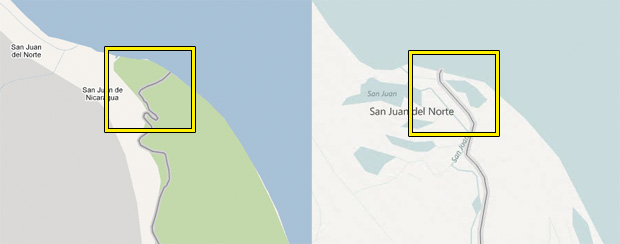
Thanks Austin Carr.
The night they burned government bonds
As I've noted before, one thing I've learned from this recession is that it's not as easy to increase the money supply as I thought.
This is Mark Thoma. But how about a big bond bonfire? (call it a bondfire if you must) How about direct financing of government debt?
I never got why Japan's lost decade was accompanied with such an explosion of government debt. The way I see it, below target inflation (let alone deflation) is a license to print money, and if the banks will do nothing with it, then the government should.
We seem to have forgotten the oldest trick in the book.
The Star Wars alphabet

Joe Wight has created the Kawaii Star Wars alphabet, with a different character for each letter of the alphabet. D, of course, is for that mean-looking fella above.
HT (and a full list of the letters in alphabetical order) Designers Couch.
Quitting smoking
I quit smoking four days ago. I am (was?) a very keen smoker, but after ten happy years of inhaling burnt tobacco I felt that the risk of cancer was starting to outweigh the pleasure of smoking.
Well, I said I quit, but I need to qualify that. I have not decided to quit for ever; I have only decided to quit for three weeks, and I will then evaluate whether I want to continue abstaining from smoking. This helps for two reasons:
- Quitting for three weeks is easier than quitting for ever. The former is a project I was willing to undertake; the latter sounded (and still sounds) too daunting to attempt.
- My nicotine addiction has already subsided somewhat, and will have subsided a lot more by the end of week three. So when at the end of week three I pose the question of what I want to do next, I'm more likely to opt for the 'quit' than the 'restart' option compared to making that decision at the height of my addiction.
Trick number three, I've started telling people - I find it hard, and painful, to break commitments and go back on my word, and even though I'm not really making any explicit commitments or promising anything to anyone, announcing that I'm undertaking this project creates expectations and I do not want to disappoint. Trick number four, I'm buying myself an iPad for Christmas, but if and only if I am still a non-smoker in two months' time.
The self-deception is, of course, crystal clear. But so far it's working.
Crazy, post-midnight thoughts on fiscal and monetary policy
When inflation is too low and you've hit the zero bound on the monetary side, and debt is too high to do anything on the fiscal side, you need to break the last taboo: direct financing of government debt by the Fed.
The only thing the Fed needs to do is to announce it fully intends to keep x amount of government bonds purchased under QE in its books till maturity - with the benefit naturally accruing to the Treasury. There would need to be some clarity on exact numbers so that nobody panics, but that's basically it.
A crazy idea - but note that this is merely a quantitative, not qualitative, deviation from the standard arrangement (even in normal times).


